1. Tell me one thing that you learned in Government class.
I have learned the three Branches of Government:The Legislative Branch, Executive Branch, and the Judicial Branch.
2. Tell me one thing that surprised you.
Well, I guess one thing that at least somewhat surprised me was that the President of the U.S. does not have all the power.
3. Tell me one thing that you did not agree with.
I did not really agree with the outcome of the Supreme Court Case "Elk Grove Unified School District v. Newdow" because I feel that the Supreme Court should have implemented a real decision rather than just leaving the case alone because of its sensitivity.
4. Explain why taking U.S. Government is important to help make you a well-rounded.
It is important to take U.S. Government because with the knowledge that this class brings, you will be more knowledgeable of the politics that happen around you. For instance if you know the three branches of Government know who controls them, and know what they do, you will be able to make smart, informed decisions when voting in elections. Moreover, if you know what the Bill of Rights is, then you will know what individual rights you have. Finally, if you what makes a U.S. citizen, then you can properly prepare for becoming a U.S. citizen.
5. How could I make Government class better?
Well, I really have no complaints for this class, but I would like to take "standard" quizzes and tests as opposed your tests. However, your tests require detailed interpretations of certain political cartoons in conjunction with knowledge from your lectures which can improve out interpretation skills, make us better test takers on tests such as the U.S. History EOC.
Wednesday, October 23, 2013

Thursday, October 10, 2013
Civil Rights and Civil Liberties
1. WWII changed America in that it gave American citizens a sense of obligation to defend America. It changed Americans' perspective of liberty and governmental power.
2. Some tensions that follows the war were the Civil Rights Act of 1964, th Cold War, and tension regarding National Security and Individual Rights.
3. I think she meant that the Supreme Court has to make a lot of decisions, regarding the law and the people that do not follow just one ideal or belief; congressmen have to change many of their decisions, too to fit what the various citizens want.
4. Rights are relative and not absolute in that the perspective of civil rights varies person to person. For instance, sexism against woman may seem fair to men, but it may not seem fair to the women. Likewise, discrimination against black men may seem fair to white men, but it is definitely not fair to the black man.
2. Some tensions that follows the war were the Civil Rights Act of 1964, th Cold War, and tension regarding National Security and Individual Rights.
3. I think she meant that the Supreme Court has to make a lot of decisions, regarding the law and the people that do not follow just one ideal or belief; congressmen have to change many of their decisions, too to fit what the various citizens want.
4. Rights are relative and not absolute in that the perspective of civil rights varies person to person. For instance, sexism against woman may seem fair to men, but it may not seem fair to the women. Likewise, discrimination against black men may seem fair to white men, but it is definitely not fair to the black man.
Wednesday, September 18, 2013

Principal Lay
Opinion: I think people should be free to practice whatever religion they wish; however, I feel that those who practice certain religions should not bash or hate those who practice a different religion or no religion at all. Lay, however, should not be punished; they should just exclude all religious activities at school. This way, those who "don't believe" will not feel uncomfortable in class and events.
Pros:
Pros:
- The Christians get to practice their faith
- People who want to become a Christian may find it at Lay
Cons:
- Those who are not Christian may find class unconformable
- Those who are not Christian may get bullied or ridiculed
Friday, September 13, 2013
Bill of Rights Scenario
Scenario #1
Amendment Violated: The Fourth Amendment
Why: This scenario violates the Fourth Amendment because the police literally enter her home without a warrant. The police violated the clause of "unreasonable search and seizure."
Scenario #2
Amendment Violated: The First Amendment
Why: This scenario violates the First Amendment because Sam had all the rights to hold his protest; however, the police prevented just that, so the clause of "freedom assembly/petition" of the First Amendment was violated.
Scenario #3
Amendment Violated: The Fifth Amendment
Why: This scenario violates the Fifth Amendment because the police cannot just force Gina out of her own home without just reason. the clause of "eminent domain" of the Fifth Amendment was violated.
Scenario #4
Amendment Violated: The First Amendment?
Why: This scenario violates the First Amendment because it because it establishes a religous viewpoint in the school.
Scenario #5
Amendment Violated: The Sixth Amendment
Why: This scenario violates the Sixth Amendment because the police arrested Hans without giving him his right to a lawyer.
Amendment Violated: The Fourth Amendment
Why: This scenario violates the Fourth Amendment because the police literally enter her home without a warrant. The police violated the clause of "unreasonable search and seizure."
Scenario #2
Amendment Violated: The First Amendment
Why: This scenario violates the First Amendment because Sam had all the rights to hold his protest; however, the police prevented just that, so the clause of "freedom assembly/petition" of the First Amendment was violated.
Scenario #3
Amendment Violated: The Fifth Amendment
Why: This scenario violates the Fifth Amendment because the police cannot just force Gina out of her own home without just reason. the clause of "eminent domain" of the Fifth Amendment was violated.
Scenario #4
Amendment Violated: The First Amendment?
Why: This scenario violates the First Amendment because it because it establishes a religous viewpoint in the school.
Scenario #5
Amendment Violated: The Sixth Amendment
Why: This scenario violates the Sixth Amendment because the police arrested Hans without giving him his right to a lawyer.
Tuesday, September 10, 2013
Articles Failure
The main purpose of this video is to inform the reader of the many aspects of the Articles of the Confederation. The Articles of the Confederation were not well liked; as a result, Federalism was created. There are three main points to the Articles of the Confederations: the good, the bad, and the ugly.
The good is the law of the Northwest Ordinance of 1787. Furthermore, there was only the Legislative Branch, and voting power was equal among the states.
Now, for the bad. The bad side of the Articles described a lack of a President, court system, army, and applicable monetary system. Also, Congress need 3/4 votes of all the 13 states just to pass laws and all votes to amend the Articles. In most cases, attaining this amount of votes is impossible.
Finally, the ugly. The Articles of the Confederation were held responsible for many unfair crimes such as taxation without representation. One man, in particular, confronted the government regarding these crimes with mobs; his names was Shay, and his revolution would be known as "Shay's Rebellion." The state governments that Shay confronted tried to call the Federal Government as a form or protection; unfortunately, as a result of Federalism, the Federal Government did not have enough power to do anything. Shay's Rebellion had some success; his rebellion scared people such as Alexander Hamilton. Fearful of this change, Hamilton wrote the Federalist Papers; these papers proposed that a new bill be written; one that will replace the Articles of the Confederation. With these papers, the US Constitution was written.
The good is the law of the Northwest Ordinance of 1787. Furthermore, there was only the Legislative Branch, and voting power was equal among the states.
Now, for the bad. The bad side of the Articles described a lack of a President, court system, army, and applicable monetary system. Also, Congress need 3/4 votes of all the 13 states just to pass laws and all votes to amend the Articles. In most cases, attaining this amount of votes is impossible.
Finally, the ugly. The Articles of the Confederation were held responsible for many unfair crimes such as taxation without representation. One man, in particular, confronted the government regarding these crimes with mobs; his names was Shay, and his revolution would be known as "Shay's Rebellion." The state governments that Shay confronted tried to call the Federal Government as a form or protection; unfortunately, as a result of Federalism, the Federal Government did not have enough power to do anything. Shay's Rebellion had some success; his rebellion scared people such as Alexander Hamilton. Fearful of this change, Hamilton wrote the Federalist Papers; these papers proposed that a new bill be written; one that will replace the Articles of the Confederation. With these papers, the US Constitution was written.
Branches of Government
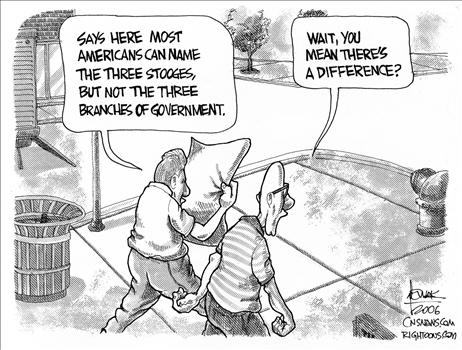
Interpretation: The nature of this photo is relatively simple to realize: the three branches of government make foolish decisions. When the man on the right says "There's a difference?" he is referring to the widespread belief the branches of the US government fail to effectively fulfill their duties.
Monday, August 26, 2013
6 Principles of Government
1.
Principle: Popular Sovereignty


Interpretation: In this picture, we can see citizens clearing a path of boulders to victory. Basically, this picture represents how the "people" have total control in the government and democracy. This fact can be inferred because there are no politicians or governors clearing the way; the people have the control and will pave their way to what they want.
2.
Principle: Judicial Review


Interpretation: In this picture, we can see the Judicial Court throwing out and excessive amount of bill and law proposals. This implies that the laws that the Legislative Branch is trying to pass is just not getting approved by the Judicial Court. The man throwing out the trash even says "Call the Sanitation-Department- we need a bigger dumpster!" This further implies that the Judicial Court is not approving of the proposed bills and laws; thus, they are happily throwing them out.
Subscribe to:
Posts (Atom)